Leave Your Message
-
 Inquiry
 -
 Email
Email -
 WhatsApp
Global buyers entering the 2026 signage market need more than a bright sample and a low quotation. An Acrylic LED Board must combine optical clarity, electrical stability, heat control, and dependable finishing. Grand View Research reports continued expansion in the global digital signage market, driven by retail, hospitality, transport, and corporate environments. This growth creates opportunity, but it also increases supplier risk. Many product pages still hide critical details.
A capable manufacturer should show measurable evidence. Ask for acrylic grade, light transmission, LED lifespan testing, color consistency, power consumption, and enclosure protection. Request production photographs, inspection records, and a traceable sample before approving a large order. The International Energy Agency continues to emphasize LED efficiency as a major lighting advantage, yet efficiency depends on drivers, thermal design, and operating conditions. Brightness alone is not proof of quality. Not even close.
The best Acrylic LED Board manufacturers for global buyers should also provide reliable export documentation, stable packaging, and responsive after-sales support. ISO 9001-based quality systems can indicate process discipline, while applicable IEC, CE, UL, or local requirements must be checked for the destination market. Certification names should never replace verification. Buyers should compare warranty terms, spare-part access, installation guidance, and realistic lead times. Market data can guide decisions, but factory evidence matters more. Some rankings remain imperfect because supplier performance changes quickly. A manufacturer praised today may struggle during peak season. Careful auditing remains essential.
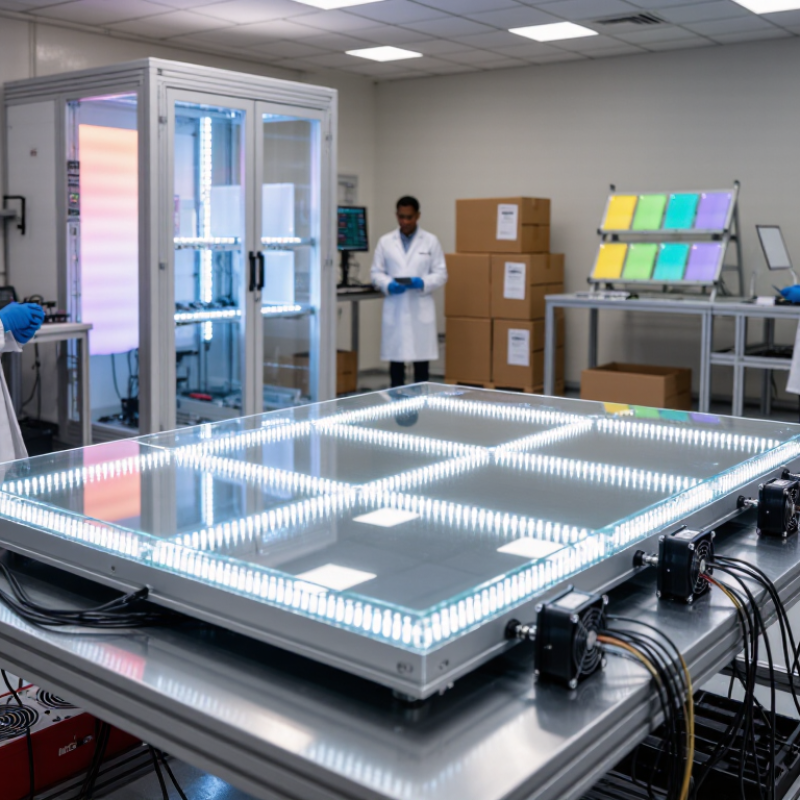
In 2026, a reliable acrylic LED board manufacturer must prove performance beyond a bright showroom sample. The International Energy Agency reports that LED lighting can use at least 75% less energy than incandescent lighting, but efficiency depends on thermal design and driver quality. A dependable supplier should provide LM-80 data, TM-21 projections, and IEC 62384 driver test records. These documents reveal how light output changes over time.
Acrylic quality matters just as much. Consistent PMMA thickness, controlled laser cutting, and tested UV resistance help prevent yellowing, hotspots, and uneven diffusion. The U.S. Department of Energy’s solid-state lighting reports emphasize thermal management and long-term reliability as major development priorities. Ask for measured luminance uniformity, operating-temperature limits, and batch inspection records. Numbers matter more than polished promises.
A low-cost sample can look perfect on day one. That is not enough. In my experience, weak edge sealing often appears only after transport, humidity, or repeated heating cycles. Manufacturers should offer aging-test photos, wiring diagrams, replacement procedures, and clear tolerances. Still, no report can predict every installation mistake. Buyers should test a production sample under real voltage and ambient conditions. Reliability is proven slowly, sometimes inconveniently.
| Evaluation Dimension | Reliable Manufacturer Benchmark for 2026 | What Global Buyers Should Verify | Evidence or Acceptance Criteria |
|---|---|---|---|
| Acrylic Material Quality | Uses clear or colored cast/extruded PMMA selected for the required optical, outdoor, and fabrication conditions. | Request the PMMA grade, thickness, surface finish, UV-resistance information, and material consistency records. | Material datasheet, incoming inspection records, approved production sample, and color or transparency tolerance. |
| Typical Acrylic Thickness | Common sign applications use approximately 3–20 mm acrylic, with thickness determined by size, mounting method, and structural requirements. | Confirm actual thickness tolerance and whether the selected thickness prevents bowing, cracking, or light leakage. | Engineering drawing, measured sample, edge-finish specification, and load or mounting assessment for large boards. |
| LED Performance | Provides consistent brightness, color temperature, viewing effect, and low-voltage operation suitable for the sign design. | Ask for LED model details, operating voltage, power consumption, color-temperature range, and photometric information. | LED datasheet, brightness test results, illuminated sample, and measured power consumption under normal operation. |
| LED Service-Life Claims | A 50,000-hour claim is commonly used in the industry, but it should be linked to stated temperature, current, testing method, and lumen-maintenance assumptions. | Do not accept an unsupported lifetime number; request LM-80, TM-21, manufacturer test data, or an equivalent technical basis where applicable. | Documented test conditions, rated current, thermal design information, and warranty terms that match the claim. |
| Electrical Safety | Uses correctly rated power supplies, insulated wiring, suitable connectors, strain relief, fuses where required, and accessible maintenance points. | Check input and output voltage, power-supply ratings, grounding requirements, wiring diagrams, and regional electrical compliance. | Electrical schematic, component certificates, production safety tests, and documentation appropriate to the destination market. |
| Ingress Protection | Indoor boards may require basic protection, while outdoor installations commonly specify sealed construction and an appropriate IP rating. | Match the IP requirement to rain, dust, cleaning methods, condensation, and the actual installation orientation. | IP test report or product test evidence, enclosure details, sealing method, and installation instructions. |
| Color and Light Uniformity | Controls LED spacing, diffusion, engraving, light guides, and internal reflectivity to reduce hotspots and dark areas. | Evaluate the complete illuminated sample rather than judging acrylic quality alone. | Approved color proof, sample photographs taken at a fixed exposure, viewing-distance test, and sign-off procedure. |
| Customization Capability | Supports CNC routing, laser cutting or engraving, printing, bending where suitable, edge polishing, mounting holes, and custom illumination layouts. | Confirm design-file formats, minimum line widths, corner radii, tolerances, artwork approval, and prototype availability. | Technical drawing, approved artwork, first-article sample, dimensional inspection report, and documented revision control. |
| Quality Management | Maintains documented inspection from raw materials through assembly, final testing, packing, and shipment. | Ask whether the quality system is independently certified and whether inspection records are retained by batch or order. | Valid ISO 9001 certificate where applicable, inspection plan, nonconformance process, and corrective-action records. |
| Regulatory Documentation | Provides documentation appropriate to the destination market, such as material declarations and applicable electrical or electromagnetic-compatibility information. | Verify that certificates apply to the actual model, power supply, configuration, and importing market. | Traceable test reports, declarations of conformity where required, RoHS or REACH-related documentation, and product labels. |
| Production and Delivery Planning | Provides a written schedule covering artwork approval, sampling, production, inspection, packing, and dispatch. | Separate sample lead time from mass-production lead time and confirm how delays or engineering changes are handled. | Purchase-order schedule, production milestones, pre-shipment inspection date, packing list, and agreed delivery terms. |
| Packaging and Export Readiness | Uses protective films, corner protection, moisture control where needed, impact-resistant outer packaging, and clear handling marks. | Review packaging drawings and confirm carton dimensions, gross weight, pallet requirements, and spare-part policy. | Packaging drop or transit assessment where appropriate, photos before dispatch, commercial documents, and traceable carton labels. |
| Warranty and After-Sales Support | Offers written coverage for LEDs, power supplies, acrylic workmanship, replacement parts, and reasonable claim procedures. | Check warranty duration, exclusions, response time, evidence requirements, spare-part availability, and installation responsibilities. | Signed warranty terms, service contact, troubleshooting guide, replacement-part list, and defined remedy for verified defects. |