Leave Your Message

Top 10 Business Sign Types for Global Buyers?

Choosing the right Business Sign is a commercial decision, not merely a branding exercise. Global buyers must balance visibility, durability, energy use, installation, and local maintenance. A bright storefront sign may attract attention, yet poor contrast can weaken readability at night. Small details matter.

Grand View Research reported that the global digital signage market was valued at approximately $27 billion in 2023. Its analysis also forecasts strong growth through 2030, driven by retail, transport, hospitality, and corporate applications. The Sign Research Foundation has repeatedly highlighted the economic value of on-premise signs. University of Cincinnati researcher James J. Kellaris stated, “On-premise signs are the most effective and least expensive form of advertising for small businesses.” This finding supports practical investment, especially for independent retailers and service providers.

The following guide examines ten Business Sign types, including channel letters, lightboxes, monument signs, pylon signs, digital displays, and window graphics. Each option serves a different site, budget, and customer journey. The International Sign Association’s industry resources also emphasize material performance, electrical quality, accessibility, and professional installation. These factors influence total ownership costs.

The ranking is not universal. Climate, building rules, viewing distance, and brand style can change the best choice. A digital display may perform well in a shopping district, but it may waste budget in a low-traffic area. A simple panel sign can sometimes work better. That is worth admitting.

For global buyers, reliable specifications matter more than impressive mock-ups. Ask for tested materials, warranty terms, maintenance guidance, and installation records. A successful sign should remain clear, safe, and useful long after delivery.

Top 10 Business Sign Types for Global Buyers?

What Business Signs Are and Why They Matter to Global Buyers

Top 10 Business Sign Types for Global Buyers

What Business Signs Are and Why They Matter to Global Buyers

Business signs are visual tools that identify, guide, and persuade customers. They include storefront signs, channel letters, monument signs, pylon signs, LED displays, banners, window graphics, wayfinding signs, dimensional letters, and digital directories. Each type serves a different location and buying purpose. A storefront sign creates recognition from the street. Wayfinding signs reduce confusion inside large facilities. Digital displays support flexible promotions, but they require careful content control.

The 2012 Consumer Signage Survey reported that 76% of consumers had entered a store because its sign attracted attention. It also found that 68% viewed signage as evidence of business quality. These figures explain why global buyers examine materials, lighting, readability, and installation details. A sign is not decoration. It is often the first physical proof of operational credibility.

In my experience, buyers sometimes focus too heavily on low unit prices. That can be a costly mistake. Thin materials may fade, warp, or look uneven after one harsh season. Poor contrast also weakens visibility at night. The Sign Research Foundation has repeatedly emphasized legibility, placement, and viewing distance in effective sign planning. Still, no single sign works everywhere. Climate, language, building rules, pedestrian speed, and maintenance access can change the result. A bright sign is not automatically a good sign.

The Ten Main Types of Business Signs Explained

Top 10 Business Sign Types for Global Buyers

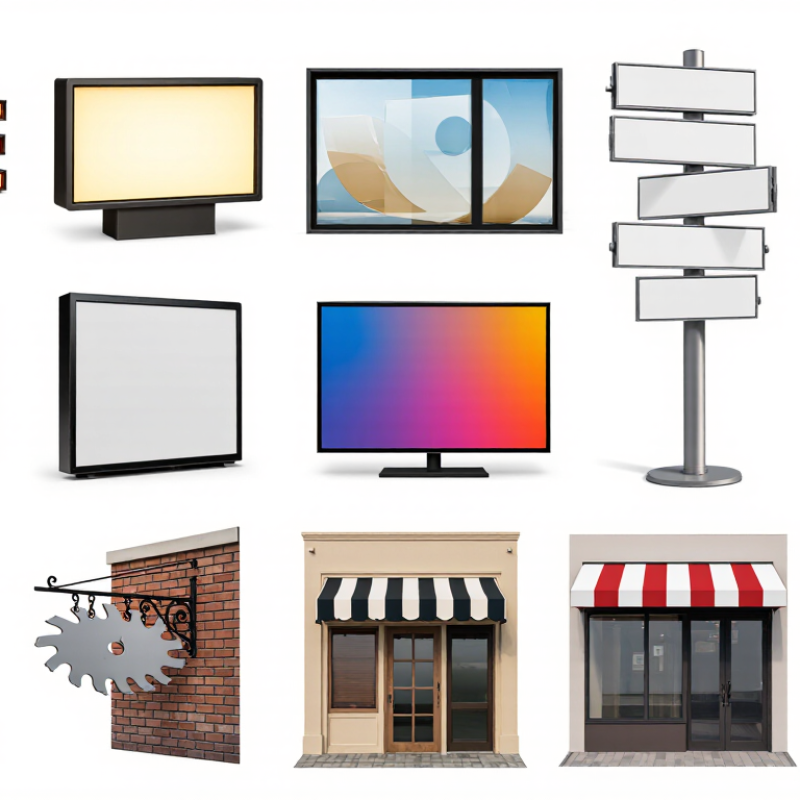
The ten main types of business signs serve different locations, budgets, and customer journeys. Storefront signs identify a business from the street. Fascia signs sit above entrances and work well on narrow façades. Projecting signs extend outward, helping pedestrians notice shops from the sidewalk. Blade signs do the same, but usually use a compact vertical format. Details matter.
Monument signs stand near entrances and suit offices, campuses, and commercial sites. Pylon signs rise higher, giving visibility across busy roads. Channel letters create individual illuminated characters for a clean, dimensional appearance. Cabinet signs use a single enclosed panel, making graphics easier to replace. Digital signs allow changing messages, but require careful brightness and maintenance planning.
Wayfinding signs guide visitors through parking areas, buildings, and reception spaces. In real projects, I have learned that sign selection depends on viewing distance, weather, wall strength, and installation access. Materials such as aluminum, acrylic, stainless steel, and treated wood offer different appearances and service lives. Local permits and accessibility requirements should be checked before production. A perfect sign on paper can fail in poor lighting. That choice can fail. Buyers should request drawings, material samples, fixing details, and realistic lead times. My own early estimates were sometimes too optimistic, especially when custom fabrication crossed borders.

Materials, Designs, and Technologies Used in Business Signage

Top 10 Business Sign Types for Global Buyers: Materials, Designs, and Technologies Used in Business Signage

Global buyers usually compare ten formats: channel letters, lightboxes, monument signs, pylons, blade signs, digital displays, window graphics, wayfinding panels, banners, and vehicle graphics. Each format needs a different material strategy. Aluminum resists corrosion and keeps structures light. Acrylic creates clean, bright faces. Polycarbonate handles impact better in demanding environments. Stainless steel adds strength, but its weight and cost require careful planning.

Design should follow viewing distance, climate, lighting, and local installation conditions. A narrow blade sign may work on a busy pedestrian street. A tall pylon sign suits a large roadside property. Digital signage adds motion and scheduled content. Grand View Research estimated the global digital signage market at about 27 billion US dollars in 2022, with strong growth expected through 2030. The report also highlights increasing demand for interactive displays and networked content. Energy use remains an overlooked issue. Efficient LEDs, ambient-light sensors, and remote monitoring can reduce operating costs, although savings depend on maintenance quality.

Tips: Request material samples before approval. Test colors in daylight and darkness. Confirm wind loads, mounting access, language needs, and screen visibility. The Outdoor Advertising Association of America reports that signage can strongly influence consumer awareness and purchase decisions. Still, larger is not always better. In practical site reviews, overloaded signs often lose clarity. A perfect design may fail when glare, poor contrast, or weak installation enters the picture. Reflect, measure, then revise.

10 Common Business Sign Types for Global Buyers

Typical service-life benchmarks by sign type, with commonly used materials, design formats, and technologies. Actual durability depends on climate, installation quality, maintenance, and operating hours.

Service-life figures are practical industry benchmarks rather than company or brand performance data.

How Global Buyers Compare Quality, Cost, and Customization

Top 10 Business Sign Types for Global Buyers?

Global buyers compare business signs through three practical filters: quality, cost, and customization. Common options include channel letters, illuminated boxes, monument signs, pylon signs, digital displays, wayfinding panels, 3D lettering, banners, building wraps, and LED message boards. Each serves a different site. A roadside pylon needs distance visibility, while lobby lettering needs clean edges and controlled lighting. A 2024 Grand View Research report valued the global digital signage market at over 27 billion US dollars in 2023, showing strong demand for programmable displays. Yet digital systems can require higher maintenance, software support, and replacement planning.

Quality begins with measurable specifications. Buyers should check aluminum thickness, LED color consistency, waterproof ratings, coating performance, wiring standards, and crate protection. For outdoor signs, an IP65-rated enclosure offers useful protection, but installation quality still matters.

Cost comparisons should include tooling, freight, duties, installation, electricity, and future repairs. The Outdoor Advertising Association of America reported 2023 out-of-home advertising revenue above 9 billion US dollars, reflecting the continuing value of visible physical media. However, that figure does not prove every sign delivers equal returns.

Customization should cover dimensions, fonts, colors, mounting systems, voltage, and local climate conditions. Requesting a physical color sample can prevent expensive surprises. In practice, buyers sometimes focus too heavily on the lowest quotation. That is a mistake. I have seen a cheaper sign lose brightness quickly because its power supply was undersized. Even careful buyers miss details. A complete drawing, material list, warranty scope, and installation guide make supplier comparisons more reliable.

Regional Regulations, Installation Needs, and Purchasing Factors

Top 10 Business Sign Types for Global Buyers

Regional rules can change the best sign choice. Channel letters suit retail façades, but some cities restrict brightness and projection. Cabinet signs offer strong visibility, especially on warehouses and roadside buildings. Monument signs work well near entrances, while pylon signs help larger sites guide distant drivers. Blade signs improve visibility along busy sidewalks. Post-and-panel signs remain practical for offices and industrial parks. Digital displays attract attention, yet authorities may control animation, luminance, and operating hours. Awnings combine branding with shade. Neon-style signs create character, but electrical certification varies by market. Wayfinding signs support campuses, hotels, and multi-building facilities.

Installation conditions deserve equal attention. Buyers should verify wall materials, wind exposure, lifting access, drainage, and available power before ordering. A heavy sign may require steel reinforcement, not simple expansion bolts. Coastal locations need corrosion-resistant hardware and sealed electrical compartments. Cold regions may require flexible materials and heaters for certain displays. Accessibility rules can affect mounting height, contrast, tactile lettering, and viewing distance. Local permits may also involve zoning, heritage, language, and illuminated-sign restrictions.

Purchasing decisions should include drawings, load data, wiring details, test reports, spare parts, and maintenance access. Ask for a sample color under daylight and nighttime lighting. It prevents expensive surprises. Shipping dimensions matter too. Oversized cabinets can increase freight costs and complicate customs clearance. A common mistake is comparing only the unit price. The cheapest sign may consume more energy or need frequent service. I still find specification gaps in otherwise careful orders, especially around voltage and mounting responsibility. Clarify those details before production begins.

Top 10 Business Sign Types for Global Buyers? — Regional Regulations, Installation Needs, and Purchasing Factors
Rank Business Sign Type Typical Applications Common Global Buying Regions Key Regional Regulatory Considerations Installation Requirements Important Purchasing Factors Overall International Fit
1 LED Channel-Letter Signs Retail storefronts, offices, shopping centers, hospitality entrances, and corporate premises. North America, Europe, the Middle East, East Asia, and Southeast Asia. Outdoor electrical installations commonly require compliance with the destination market's low-voltage, wiring, grounding, and energy-efficiency rules. Building façades may also require landlord or municipal approval. Requires a level mounting surface, concealed or protected wiring, suitable power supplies, weather sealing, and access for future LED servicing. Letter depth, illumination uniformity, IP rating, power consumption, color temperature, transformer quality, mounting templates, and replacement-part availability. High
2 Illuminated Cabinet Signs Large retail façades, supermarkets, dealerships, commercial buildings, and roadside premises. North America, Latin America, the Gulf region, Australia, and parts of Asia. Sign area, projection from the building, brightness, structural loading, and electrical safety are frequently controlled by local authorities. Some jurisdictions limit sign illumination near residential areas or roads. Needs a strong wall or independent frame, anchor calculations, weatherproof cable entry, and crane or lifting equipment for large formats. Cabinet weight, wind-load resistance, aluminum or galvanized construction, acrylic or polycarbonate face quality, LED access, shipping volume, and maintenance cost. High
3 Pylon and Monument Signs Business parks, shopping complexes, hotels, hospitals, campuses, and roadside developments. North America, the Middle East, Australia, Europe, and rapidly developing urban markets. Usually subject to planning permission, setback rules, maximum height limits, visibility restrictions, and engineered foundation requirements. Local wind and seismic conditions may affect design approval. Requires a reinforced concrete foundation, underground utilities, lifting equipment, and structural engineering appropriate to soil and wind conditions. Overall height, foundation design, wind rating, modular tenant panels, corrosion protection, transport dimensions, installation access, and long-term serviceability. High for large sites
4 Digital LED Display Boards Outdoor advertising, transport hubs, stadiums, city-center retail, and public information displays. Asia-Pacific, North America, the Middle East, Europe, and major Latin American cities. Brightness, operating hours, animation, refresh behavior, traffic distraction, content control, and electromagnetic compatibility may be regulated. Outdoor displays often require specific permits and engineering documents. Needs a rigid steel structure, ventilation, drainage, high-capacity electrical supply, data connectivity, remote monitoring, and safe maintenance access. Pixel pitch, brightness control, viewing distance, refresh rate, thermal management, IP rating, software compatibility, spare modules, energy use, and warranty support. Medium to high
5 Wayfinding and Directional Signage Airports, hospitals, universities, industrial parks, malls, resorts, and public facilities. Worldwide, especially in complex multi-building sites and public infrastructure projects. Public projects may specify accessibility, contrast, text height, pictograms, multilingual content, tactile information, and standardized directional symbols. Fire-escape signs may follow separate safety rules. Can be wall-mounted, ceiling-suspended, post-mounted, or surface-fixed. Placement must preserve accessible routes, sightlines, and emergency egress. Legibility distance, multilingual layout, anti-glare finish, modular panels, tactile or Braille features where required, UV resistance, and ease of updating. Very high
6 Freestanding Post and Projecting Signs Restaurants, retail stores, service stations, small businesses, and urban storefronts. Europe, North America, Southeast Asia, Australia, and urban areas in Latin America. Municipal rules may regulate projection over public paths, clearance above pedestrian areas, sign area, illumination, and placement near roads or heritage buildings. Requires secure brackets or posts, correct clearance from pedestrians and vehicles, protected cabling, and a wall or foundation capable of carrying wind and impact loads. Projection distance, bracket strength, pedestrian clearance, corrosion resistance, sign visibility, local permit complexity, and compact shipping design. High for small and medium sites
7 Digital Menu Boards Restaurants, cafés, food courts, cinemas, convenience stores, and drive-through facilities. North America, Europe, Australia, East Asia, and the Middle East. Electrical safety, accessibility, glare, food-service hygiene, and consumer information rules may apply. Outdoor drive-through installations may need additional planning and traffic-safety review. Needs a stable wall, ceiling, or freestanding mount, dedicated power, network connectivity, ventilation, and easy front or rear access for servicing. Screen brightness, operating temperature, content-management compatibility, touch requirements, screen size, energy consumption, mounting orientation, and remote support. High
8 Safety, Exit, and Emergency Signs Factories, offices, hotels, warehouses, hospitals, schools, and public buildings. Worldwide, with especially strict requirements in commercial, industrial, and public facilities. Often governed by local fire, building, occupational-safety, and electrical codes. Pictograms, colors, visibility, emergency duration, mounting height, and backup power may be prescribed. Must remain visible during normal and emergency conditions. Installation may require maintained or non-maintained operation, battery backup, testing access, and unobstructed placement. Certification for the destination market, battery duration, self-test functions, viewing distance, photoluminescent performance, ingress protection, and inspection records. Very high, but compliance-critical
9 Temporary Event and Construction Signs Trade shows, festivals, property developments, construction sites, sports events, and promotional campaigns. Worldwide, particularly in fast-changing commercial and construction environments. Temporary signs may still require permits, public-liability controls, traffic management, pedestrian protection, and restrictions on advertising content or placement. Requires ballast, portable frames, weighted bases, wind monitoring, anti-trip cable management, and rapid assembly without permanent structural alteration. Setup speed, reusability, pack-down size, weather resistance, ballast requirements, graphics replacement, transport cost, and rental-versus-purchase economics. High for short-term projects
10 Vehicle and Fleet Graphics Delivery vans, service vehicles, buses, trailers, municipal fleets, and mobile advertising. North America, Europe, Australia, the Middle East, and urban markets worldwide. Rules may address reflective materials, window visibility, emergency-vehicle appearance, commercial vehicle identification, and local advertising restrictions. Vehicle-owner approval is essential. Requires thorough surface preparation, controlled application temperature, trained installers, edge sealing, and removal methods that protect the vehicle finish. Film durability, UV and weather resistance, conformability, removable adhesive, print color consistency, installation turnaround, cleaning requirements, and replacement panels. Very high for mobile visibility
Note: Permit procedures, electrical approvals, accessibility rules, structural calculations, brightness limits, and fire-safety requirements vary by country, municipality, building type, and installation location. Buyers should confirm the final specification with the local authority, property owner, and a qualified installer before production.