Choosing the right Wall Mounted Business Signs can shape how customers judge a company before entering. A clear sign works like a quiet salesperson. It identifies the location, communicates professionalism, and remains visible after sunset. For global buyers, however, the decision involves more than attractive lettering. Material quality, mounting strength, lighting performance, packaging, and installation conditions all deserve careful review.
This guide presents ten practical sign types for offices, retail stores, hotels, restaurants, and service businesses. Each option is considered through real purchasing concerns, including aluminum durability, acrylic clarity, stainless steel finishes, LED energy use, and resistance to rain or strong sunlight. Product dimensions also matter. A sign that looks balanced on a showroom wall may appear too small above a wide storefront. That mistake is common.
Small details matter.
Buyers should compare drawings, surface finishes, wiring information, warranty terms, and replacement support before placing an order. Local building requirements and electrical standards may differ, so professional installation remains important. We do not treat one design as universally superior. A bright illuminated sign may attract attention, yet it can increase maintenance needs. A simple metal logo may last longer, but it may offer less nighttime visibility. These trade-offs are easy to overlook in polished product photos. The following selection aims to provide dependable ideas, realistic comparisons, and useful questions for making a more informed international purchase.
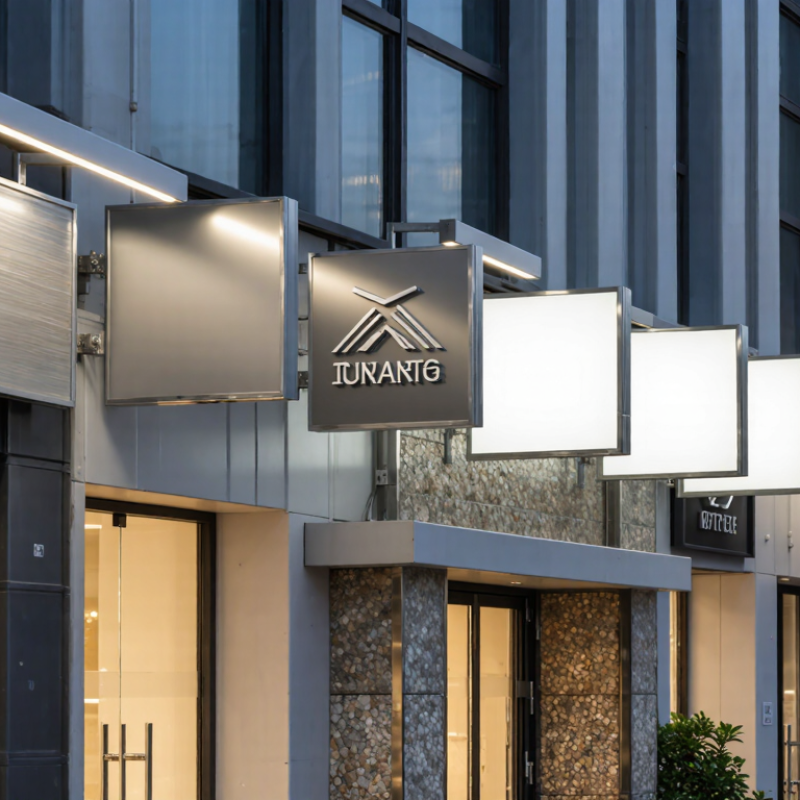
Wall-mounted business signs come in several practical forms for global buyers. Flat-cut metal letters offer a crisp, architectural appearance on stone, concrete, or painted walls. Acrylic letters create a lighter, modern look, especially when paired with concealed spacers. They are easy to clean, but thin acrylic can appear weak on large façades.
Illuminated channel letters improve visibility after sunset. Front-lit versions create clear lettering, while halo-lit designs cast a soft glow behind each character. A compact lightbox sign delivers strong contrast and useful interior lighting. However, its depth may dominate a narrow storefront.
Projecting blade signs extend outward from the wall, helping pedestrians notice a business from both directions. They suit corner locations and busy walkways.
Custom plaques, engraved metal panels, and wood-look signs work well for offices, hotels, clinics, and professional buildings. Wood can add warmth, though outdoor moisture may expose poor finishing quickly.
Digital wall displays allow changing information, but they require reliable power and careful brightness control. That detail is often underestimated.
Material thickness, mounting hardware, wall structure, and climate should guide the purchase. Coastal buyers may need corrosion-resistant metals and sealed electrical components. Buyers in snowy regions should check load support and drainage. Local installation rules also matter.
A sign that looks perfect in a workshop can feel oversized on-site. I have seen this mistake repeatedly. Confirming viewing distance, wall measurements, lighting conditions, and maintenance access before production prevents expensive revisions.
Wall-mounted signs vary in construction, even when their faces look similar. Aluminum-panel signs use folded or welded edges to resist flexing. Acrylic face signs offer clean color and even light, but exposed edges can scratch. Stainless-steel letters provide crisp depth; their mounting studs need accurate spacing. Routed wood plaques feel warm indoors, though moisture can change their shape. Small details matter.
For illuminated options, cabinet lightboxes rely on a rigid frame, a diffusing face, and accessible electrical components. Halo-lit letters need stand-offs that preserve an even gap from the wall. Edge-lit acrylic panels use engraved lines, but dust around the light source can reduce clarity. Blade signs project outward on metal brackets, so bracket strength and wall anchors deserve attention. Modular panel systems simplify updates, while dimensional foam signs stay light but need a durable coating. Vinyl graphics on aluminum are economical; poor surface preparation can cause early peeling. No material is automatically best. Check viewing distance, exposure, cleaning needs, and the wall itself before choosing. I would question any specification that omits fixing details. A neat face can hide weak construction.
A practical comparison of common wall-mounted sign types, their materials, construction, lighting, and installation considerations.
| No. | Sign Type | Typical Face or Letter Materials | Construction Features | Lighting Options | Mounting and Use Considerations |
|---|---|---|---|---|---|
| 1 | Aluminum Composite Panel Sign | Aluminum composite panel (ACP), commonly made with thin aluminum skins and a polymer core | Flat, lightweight panel with printed, painted, or applied vinyl graphics; edges may be folded or fitted into a frame | Usually non-illuminated; can be paired with external spotlights | Suitable for exterior walls when fixed to a stable support. Panel thickness, fixing method, and wind exposure should be checked for the installation site. |
| 2 | Fabricated Aluminum Cabinet Sign | Aluminum cabinet with an acrylic or polycarbonate face | Enclosed box-style construction with formed aluminum returns and a removable service panel for electrical access | Internal LED modules are commonly used for face illumination | Requires secure wall anchors and a suitable electrical connection. Drainage and sealed joints help manage outdoor moisture. |
| 3 | Acrylic-Face Lightbox | Translucent acrylic face with an aluminum or steel cabinet | Graphics are printed or applied to the face; the cabinet depth provides space for light sources and wiring | Typically internally illuminated with LEDs | Useful where readable signage is needed after dark. Face size, cabinet depth, and access for maintenance should be planned together. |
| 4 | Front-Lit Channel Letters | Aluminum letter returns with translucent acrylic faces | Individual three-dimensional letters are assembled separately and mounted directly or on a raceway | LED modules illuminate through the front faces | Letters need accurately positioned fixings and concealed or protected wiring. A raceway can simplify installation and servicing. |
| 5 | Halo-Lit (Reverse-Lit) Letters | Opaque aluminum or stainless-steel letter faces and returns, often with open backs | Letters stand slightly away from the wall so light can spread behind them and create a halo effect | Rear-facing LEDs illuminate the wall behind each letter | Works best on a relatively even surface with enough space behind the letters. Wall color and texture affect the appearance of the halo. |
| 6 | Non-Illuminated Dimensional Letters | Acrylic, aluminum, stainless steel, PVC, or other suitable rigid materials | Cut or fabricated individual letters with flat or dimensional profiles; can be installed with studs or mounting tape where appropriate | None; external lighting can be added separately | Material and fixing choice depend on letter size, wall substrate, and indoor or outdoor exposure. Stud mounting is common for heavier letters. |
| 7 | Projecting Blade Sign | Aluminum frame with aluminum, acrylic, or composite sign panels | Projects perpendicular to the building wall, usually using a bracket or support arm; may be single- or double-sided | Non-illuminated, externally lit, or internally illuminated depending on construction | Requires structural attachment to the wall and consideration of pedestrian clearance, local rules, and wind loading. |
| 8 | Routed HDU Sign | High-density urethane (HDU) sign board with paint or compatible surface coatings | Letters and decorative details can be routed or carved into the board; the finished sign may be flat or layered | Usually non-illuminated; external lighting is an option | Commonly used for detailed, non-lit signs. Coating and installation methods should be selected for the expected weather and wall conditions. |
| 9 | Stainless-Steel Lettering | Stainless-steel sheet or fabricated stainless-steel letters | Letters may be flat-cut or formed with returns; brushed and polished finishes are common | Usually non-illuminated; can be fabricated for halo lighting | Suitable for a clean metallic appearance. The alloy grade, finish, and cleaning plan should reflect the site’s humidity, pollution, and coastal exposure. |
| 10 | LED Neon-Flex Sign | Flexible LED neon-style tubing mounted on acrylic, aluminum, or another rigid backing | Flexible illuminated tubing is shaped into lettering or graphics and secured to a backboard or wall-mounted supports | Integrated LED illumination; a compatible power supply is required | Check the product’s rated environment, power-supply location, cable routing, and service access. Outdoor use requires components and installation rated for that exposure. |
Specifications vary by supplier, sign size, local regulations, wall construction, and environmental conditions. Confirm material ratings, electrical requirements, wind-load design, and installation details for each project.
Wall-mounted business signs help customers recognize an entrance, find a service, and remember a business. The right choice depends on viewing distance, daylight, and the building’s surface. A small office may need a neat, unlit panel beside its door. A busy shop may benefit from illuminated lettering that stays legible after sunset. Halo lighting creates a softer outline, while front-lit faces offer stronger contrast. Neither option suits every setting. Glass, brick, and uneven walls can change how a sign appears once installed.
Tips: Check visibility from the pavement, not just up close. Ask for a night-time lighting sample, and confirm mounting measurements before production. Allow space around the sign.
Branding works best when shape, color, and lettering feel consistent with the business interior. A clinic might favor clear lettering and calm colors; a café may choose warmer illumination and a more distinctive silhouette. For global buyers, compare weather exposure, power access, material finish, and installation requirements with the supplier. These details affect upkeep as much as appearance. A design that looks perfect on screen can feel crowded on a real wall; a site photo and scale drawing can reveal that before the sign is made.
Global buyers should treat size as a market decision, not a decoration choice. A 900 mm facade sign may suit a narrow European storefront, while a 1,800 mm sign may remain readable across a wider North American setback. The World Out of Home Organization reported global out-of-home advertising revenue above 40 billion US dollars in 2023, showing strong demand for visible commercial communication. Yet visibility does not excuse poor proportion. Measure viewing distance, wall width, pedestrian flow, and night contrast before approving artwork.
Installation conditions change by market. Masonry walls may require expansion anchors, while insulated panels often need reinforced subframes. Coastal locations demand corrosion-resistant fasteners and sealed cable entries. A licensed electrician should verify illuminated signs, earthing, and emergency isolation. In the United States, accessibility rules can affect mounting height and clearances. European projects may reference EN 17210 principles, but local planning rules still control. They are not interchangeable.
Compliance needs a documented check. Confirm landlord approval, municipal permits, electrical certification, language rules, brightness limits, and wind-load calculations. The International Building Code uses location-specific wind provisions, so one mounting detail cannot serve every country. A 2024 signage market report from Grand View Research indicates continuing growth in digital and illuminated signage, but growth can encourage rushed specification. That is a weakness. I have seen attractive drawings fail because the fixing points missed the structural frame. Leave room for inspection, drainage, future access, and honest mistakes.
Comparing the top ten wall mounted business signs requires more than checking the purchase price. A low quote may exclude artwork, mounting hardware, export packaging, installation, and customs charges. Calculate the landed cost per sign. Then estimate cleaning, repairs, electricity, and replacement parts over five years. The U.S. Department of Energy reports that LED products use at least 75% less energy than incandescent lighting and can last up to 25 times longer. That difference matters for signs operating every evening.
Durability depends on climate, not just material thickness. Ask suppliers for corrosion tests, UV resistance data, ingress protection ratings, and fastener specifications. In coastal areas, stainless fasteners and sealed electrical connections deserve priority. The World Bank’s 2023 Logistics Performance Index shows major differences in customs efficiency and delivery reliability across markets. Request production photographs, sample approvals, packaging dimensions, and a written replacement policy. My earlier comparisons focused too heavily on the unit price. That was a mistake. A cheaper sign can become expensive after one damaged shipment or a failed power supply.
Tips: Build one comparison sheet for every supplier. Record material grade, lighting method, warranty length, delivery terms, certifications, and spare-part availability. Ask for a real quotation based on your wall size and destination country. Generic estimates often hide costs. Also inspect the supplier’s quality process, not only its showroom. A polished sample can still conceal weak sealing or uneven illumination. Leave room for uncertainty. Weather exposure is difficult to predict.